Where the Game Came From
The earliest printed description of Hangman appears in Alice Bertha Gomme's Traditional Games of England, Scotland, and Ireland(1894), under the title Birds, Beasts, and Fishes. The rules match what we play today: one player picks a word, the other guesses letters, and a stick figure is drawn one limb at a time for each wrong guess. By the early twentieth century the game had spread through schools across the English-speaking world. It became a staple of paper-and-pencil puzzles and, much later, of children's television (Wheel of Fortune, descended from Hangman, first aired in 1975).
The game's brilliance is mathematical, not macabre. With a fixed alphabet, narrow letter frequency, and a hard cap on wrong guesses, Hangman is one of the cleanest skill-vs-luck puzzles ever invented. Computer scientists have studied it for decades; Jon McLoone's 2010 analysis for Wolfram showed that an optimal solver beats a human at roughly four words in five.
The Seven Executions
The Gallows
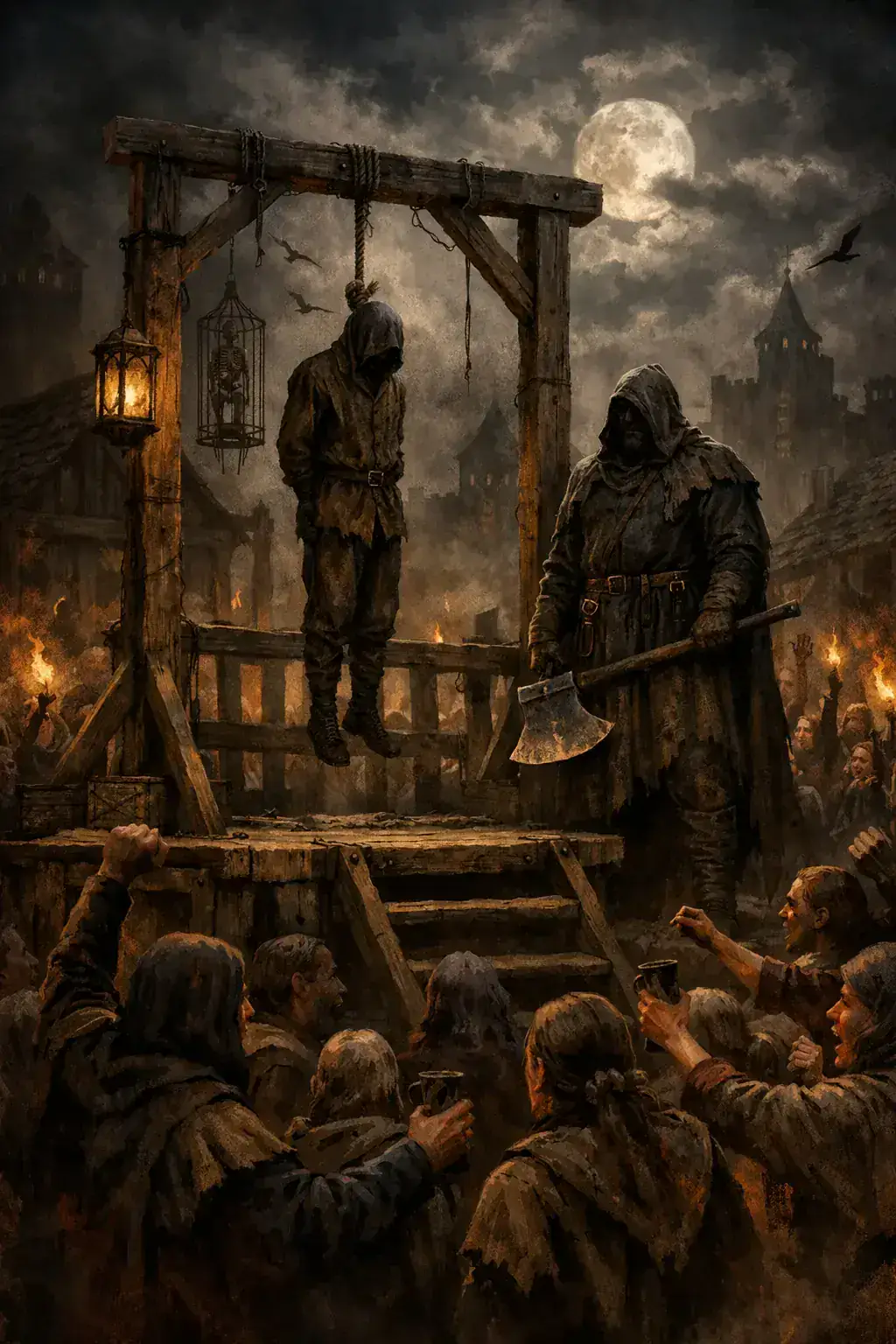
Hanging is the oldest form of judicial execution still depicted in Western iconography. The word gallows comes from Old English galga, itself from a Proto-Germanic root meaning branch or pole. The medieval gallows was a simple beam between two posts; the more elaborate triangular Tyburn Tree in London could hang twenty-four people at once and stood from 1571 until 1783. The "long drop" method, calculated to break the neck instantly using the prisoner's body weight, was refined by the executioner William Marwood in the 1870s and made hanging comparatively humane by Victorian standards.
The Guillotine
Named for Joseph-Ignace Guillotin, a French physician who in 1789 argued before the National Assembly that capital punishment should be equal across class lines and as painless as possible. Guillotin did not invent the device — similar machines existed in Italy, Germany, and Scotland for centuries — but his advocacy gave it his name, which he reportedly hated for the rest of his life. The guillotine was used in France until 1977; the last public execution was that of Eugen Weidmann in Versailles, June 1939, after which the spectacle was moved behind prison walls.
The Firing Squad
Firing squads emerged with the rise of professional armies in the seventeenth century. Standard practice in many militaries was to load one rifle with a blank cartridge so that no individual soldier could be certain they had fired the lethal shot — a psychological safeguard known as the "conscience round." Firing squad executions remain legal in a handful of jurisdictions today, including several US states, where they are considered among the fastest and most reliable methods of execution.
The Iron Maiden
The iron maiden is, ironically, the least historical of the seven. The most famous example — the Iron Maiden of Nuremberg, photographed endlessly in nineteenth-century travel books — is almost certainly an Enlightenment-era fabrication, assembled from older parts to feed a public appetite for medieval cruelty. Real torture devices of the Inquisition era did exist (the rack, the strappado, the thumbscrew), but the spiked sarcophagus was largely a Victorian invention. We include it in The Kremala because the myth has become more famous than the truth — itself a worthwhile subject.
Witch-Burning at the Stake
Between roughly 1450 and 1750, an estimated forty to fifty thousand people — overwhelmingly women — were executed in Europe and the American colonies on charges of witchcraft. The peak years were 1580–1630, during the religious upheavals of the Reformation and the Thirty Years' War. Burning was the most common method in continental Europe and Scotland; in England and the American colonies (Salem most famously), the accused were typically hanged. The Salem witch trials of 1692 ended with twenty deaths — nineteen by hanging and one (Giles Corey) pressed to death by stones.
Stoning
Stoning is one of humanity's oldest recorded methods of execution, appearing in law codes from ancient Babylon to Rome. In the Roman world, capital punishment carried out by the crowd — known as lapidatio — blurred the line between justice and spectacle, and it is the method by which figures such as Saint Stephen, the religion's first martyr, met their end. Unlike other forms of execution, stoning distributes the fatal act across an entire crowd, which is part of why it remains one of the most chilling practices to study. It is also the most ancient execution style in The Kremala, set before a Roman crowd with a religious figure handing out the stones.
Drawn and Quartered & the Electric Chair
In France, the most extreme sentence for regicide was écartèlement: the condemned was tied by the wrists and ankles to four horses, which were driven in opposite directions. Robert-François Damiens, who stabbed Louis XV in 1757, was executed this way on the Place de Grève in Paris before an enormous crowd; contemporary accounts describe the horses struggling for over an hour. (In England, "hanged, drawn and quartered" was a related but different punishment for high treason.) The Kremala's version ties the prisoner to one more horse with every wrong answer until the pistol fires.
Why a Game About This?
Death has always been a teacher. Folk tales, morality plays, and gallows ballads were a way of passing on rules — about justice, mercy, evidence, and the human capacity for both — across generations that could not read. Hangman survives in school notebooks for the same reason: it is a small, harmless ritual about consequence. The Kremala takes that frame seriously, treats the history with care, and pairs it with curated trivia so the round you just lost teaches you something true on the way out.