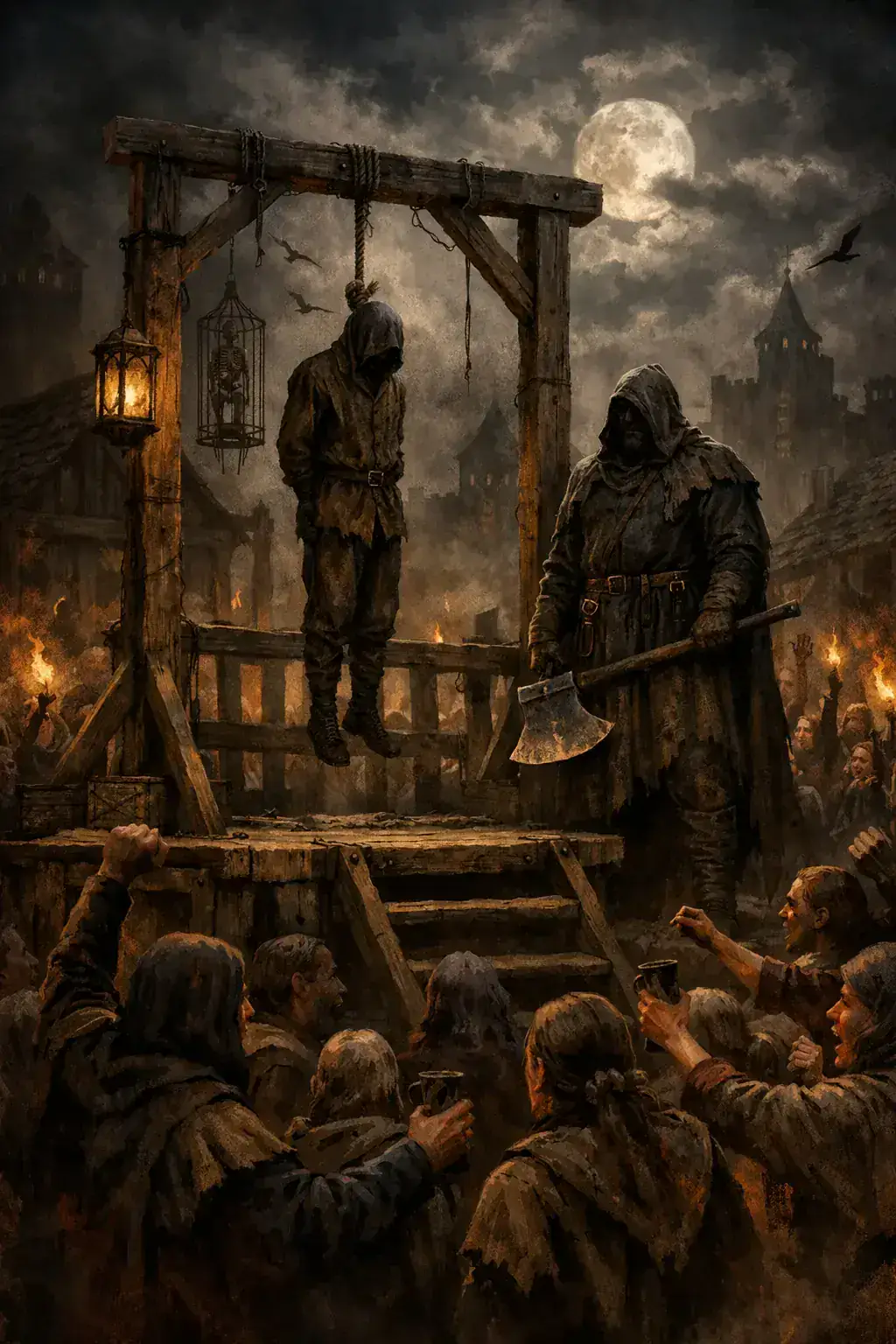
Origins
Hanging as judicial execution dates to at least 5th century BCE Persia, where Herodotus recorded it as a method of displaying the condemned after death — a visible warning to the living rather than a method of killing them. The transition from post-mortem display to execution by hanging was gradual, and different cultures arrived at it independently.
The Germanic tribes of northern Europe used hanging as a sacrificial offering to Odin — the Norse god was himself hung from Yggdrasil for nine days in the creation of the runic alphabet. Hanging had religious as well as penal dimensions.
In England, hanging became the standard method of execution by the 10th century. William the Conqueror reportedly abolished capital punishment entirely, but his successors reversed this within a generation. By the medieval period, hanging was the default sentence for felonies — crimes against property as well as crimes against persons.
Tyburn and the Theater of Death
Tyburn, located approximately where Marble Arch stands today in London, served as London's primary execution site from 1196 to 1783. Over that period, an estimated 1,200 people were hanged there — though some historians place the number significantly higher.
The "Tyburn Tree" — a triangular gallows erected in 1571 — could accommodate up to 24 simultaneous hangings. It stood in place until 1759.
Public hangings at Tyburn were social events. Execution days were declared public holidays. Crowds of tens of thousands attended. Vendors sold food, alcohol, and commemorative ballads celebrating the condemned. The journey from Newgate Prison to Tyburn — approximately three miles — took several hours and passed through streets lined with spectators. The body of the hanged was typically left on display — sometimes for weeks — as a deterrent.
Famous Tyburn hangings include Jonathan Wild (thief-taker general turned crime lord, 1725) and Jack Sheppard (escape artist and thief, 1724), whose names were celebrated in street ballads that served as the tabloid journalism of their era.
The Short Drop and the Long Drop
For centuries, the method was the "short drop" — the condemned stood on a cart or ladder, the noose was placed around their neck, and the support was removed. Death came from strangulation, which could take anywhere from several minutes to twenty or more. The family of the condemned, or paid "hangers-on," would sometimes rush forward and pull on the condemned's legs to hasten death. This is the likely origin of the phrase "hangers-on."
William Marwood, a Lincolnshire cobbler turned executioner, introduced the "long drop" in 1872 — a calculated fall distance based on the condemned's weight, designed to snap the cervical vertebrae and cause near-instantaneous death. Too short a drop and the condemned strangled. Too long and decapitation occurred. The official Home Office "Table of Drops" remained in use until Britain abolished capital punishment in 1965.
Public Execution Ends
Public executions in England ended in 1868. Charles Dickens, who attended public hangings and wrote about them with horror, was among those who campaigned for their abolition.
The last public hanging in the United States occurred in Owensboro, Kentucky, on August 14, 1936. Rainey Bethea was hanged before an estimated crowd of 20,000 people. Capital punishment by hanging continued privately in the United States until the 1990s.
In The Kremala
The Gallows mode is free to all players. The word bank draws from the vocabulary of English criminal history — Tyburn, gallows, noose, gibbet, reprieve, condemned, Newgate, felony, commutation, scaffold — and from the broader cultural vocabulary that hanging left behind. Many common English phrases — "left hanging," "rope's end," "given enough rope" — have their origins in this history.
Every wrong guess in The Kremala's Gallows mode draws one step closer to what Tyburn's crowds came to see. Play free at thekremala.com.